
January 26, 2026
On the occasion of the International Day of Clean Energy, the Iraqi Observatory for Human Rights (IOHR) issues a stark warning: the Iraqi people are being systematically choked by an "environmental genocide" sanctioned by decades of institutional failure and the entrenchment of corrupt interest networks. While the average citizen struggles to bear the exorbitant costs of private electricity—which drains between $6 billion and $10 billion annually from household savings—they find themselves facing a "chemical guillotine" that pumps toxic fumes directly into their homes.
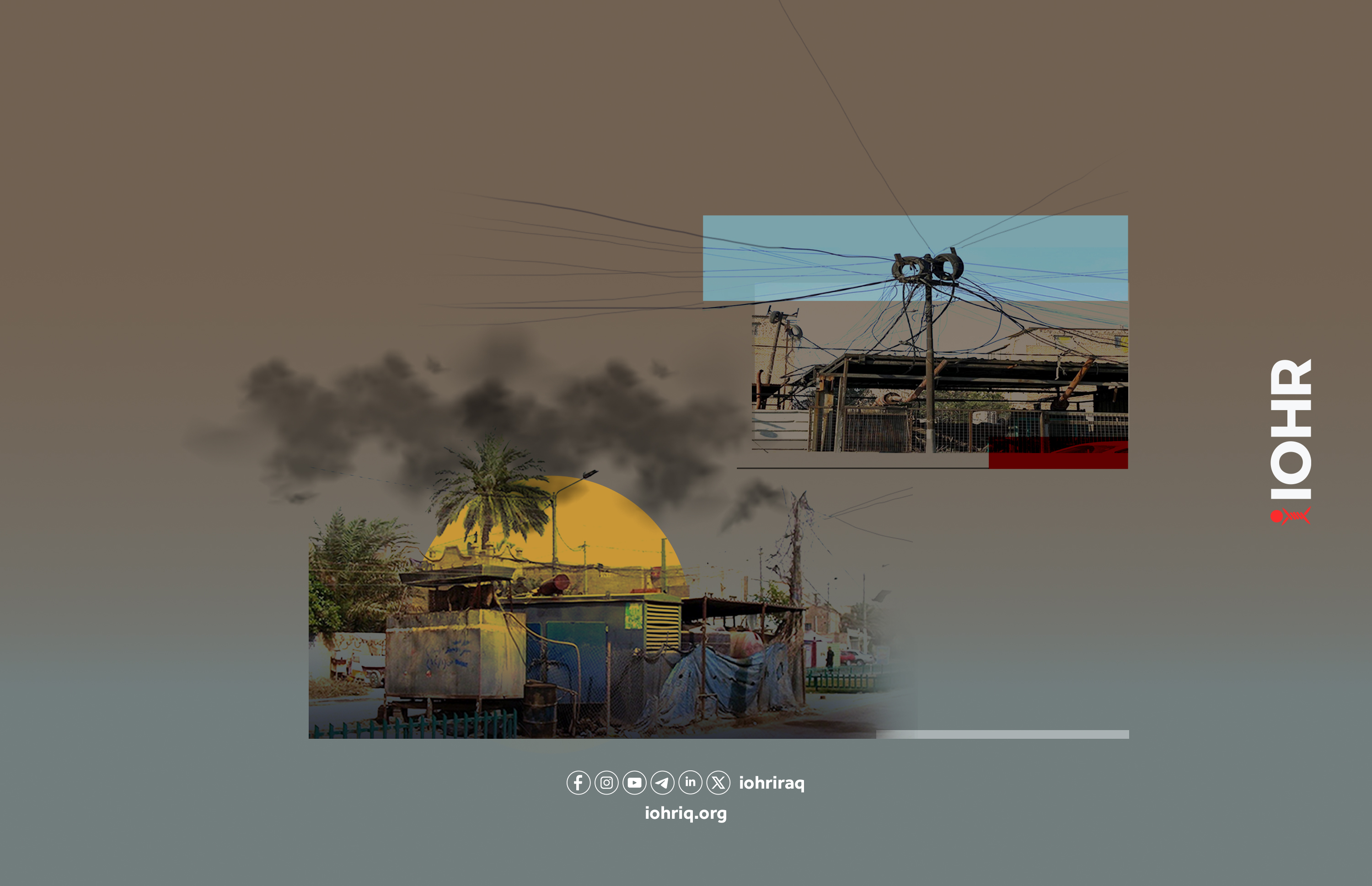
According to the Earth Protection Program (EPP) at IOHR, Iraq's skies have been surrendered. What was once part of the natural climate has been transformed into an atmospheric dump for the hazardous gaseous waste emitted by approximately 50,000 registered generators (and nearly 100,000 in total). These units, often powered by dilapidated engines and high-sulfur diesel, pushed Baghdad to the top of the world’s most polluted cities in early 2026, with an Air Quality Index (AQI) hitting a catastrophic 301.
Urban centers are now besieged by a heavy "black cloud" that traps fine particulate matter and carcinogens close to the ground, unleashing a lethal sulfur stench that peaks during the late night and dawn hours. This degradation is no mere technical glitch; it is a form of "national suicide." It is fueled by a pervasive culture of impunity that shields "generator mafias" linked to political powerhouses. As a result, 45% of the population is exposed to immediate health risks, contributing to a surge in cancer cases, which reached 46,390 recorded instances in 2024 alone.
Mustafa Saadoon, President of IOHR, stated: "The failure of successive governments is not limited to their inability to provide power; they have effectively legalized pollution through thousands of 'ghost generators' that siphon off state fuel to be sold on the black market. If these 'diesel fiefdoms' are not dismantled and a transition to sustainable energy is not initiated immediately, some of our cities may become uninhabitable by 2030."
The EPP experts argue that the Iraqi state is committing a "crime of systemic negligence." Relying on private generators as a primary power source is a flagrant violation of the Right to Life and Health, as enshrined in Article 33 of the Iraqi Constitution. Iraqis are trapped in a distorted social contract, forced to pay billions only to have their lungs filled with poison. Saadoon adds: "Public health has become a commodity traded in the corrupt market of fuel quotas."
The Smog of Despair: A Meteorological Crisis
In early 2026, IOHR monitored a historic spike in Baghdad’s AQI, reaching a level internationally classified as a "Purple Alert"—meaning the air has reached acute toxicity, requiring an emergency health declaration. Residents describe the sky as a permanent "photochemical smog," a dark gray haze with a pungent sulfuric odor. This is the result of burning low-grade diesel with sulfur concentrations between 10,000 and 25,000 parts per million ($ppm$). The combustion releases Hydrogen Sulfide ($\text{H}_2\text{S}$) at levels 120 times higher than the World Health Organization’s safe limit.
Living in the Furnace: Voices from the Ground
The pollution has infiltrated the state's own sovereign facilities. An employee at the Doura Thermal Power Plant in Baghdad—speaking on condition of anonymity—described a "criminal" working environment. Thick, toxic smoke leaves a layer of black soot on the staff’s faces and clothes, entering their lungs directly. She spoke with a raspy voice, a permanent result of vocal cord damage from continuous exposure. "Most of my colleagues suffer from chronic respiratory infections. There are no safety measures or filters," she said. Her testimony mirrors reports from Environmental Police confirming heavy emissions from the 1960s-era plant. Nearby, local business owners in the Doura district report escalating heart conditions among their workers.
In Baghdad’s Al-Mansour district, civil activist Ruwa Khalaf has been fighting a year-long legal battle against six commercial generators surrounding her home. Despite noise levels exceeding 65 decibels and constant fumes choking her children, the case remains stalled. She attributes this to "black money" bribes used by owners to bypass inspections. This corruption is systemic; the Federal Integrity Commission has identified thousands of "ghost generators" registered solely to collect free state fuel (granted by a 2025 Cabinet decree) and sell it on the black market.
The biological destruction extends to the soil. Mustafa Al-Zaeem, a resident of Kirkuk since 1994, describes how a local generator has turned his neighborhood into a "dead zone." Oil leaks have saturated the ground, and the surrounding trees are yellowed and stunted. "These machines are killing the vegetation as surely as they are killing our peace," he told IOHR,
Medical professional Dr. Rahma Alaa documented her own decline in health while living in Karbala. She suffers from frequent epistaxis (nosebleeds) and severe respiratory irritation that only manifests while she is in Iraq. The toxic sulfuric gases dehydrate the mucous membranes and weaken nasal capillaries. "The symptoms vanish entirely the moment I leave the country," she noted, highlighting the direct link between generator smog and physiological damage.
The Failure of Governance and the Dying Land
Iraq currently flares 18 billion cubic meters of associated gas annually—enough to generate 33 gigawatts of clean electricity and eliminate the need for private generators. Yet, the "generator economy" remains the sole beneficiary of this waste. EPP experts predict a catastrophe: by 2030, 70% of Iraq’s land could become "dead zones" due to pollution and drought, while urban temperatures will rise by another 5.5°C, forcing more than 140,000 people to flee their homes annually.