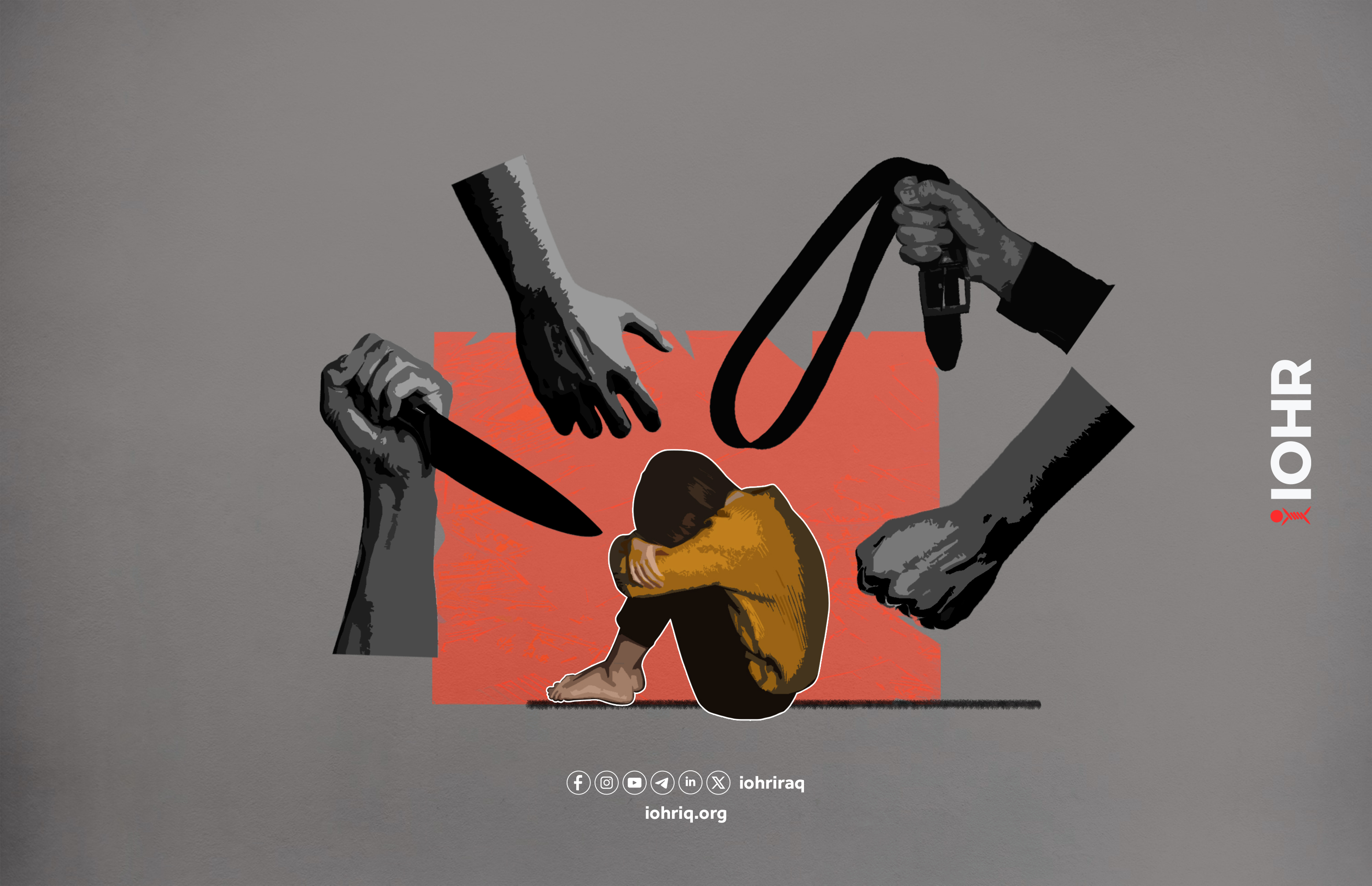

This statement examines the crisis of domestic violence in Iraq, in light of the registration of more than 36,000 cases during 2025, while emphasizing that the announced figures do not reflect the true scale of violations. It points to the existence of silent victims hindered by stigma and the weakness of legal protection, calling for legislative reforms and the provision of a safe environment that protects the family and ensures the dignity of individuals.
February 18, 2026
The Iraqi Observatory for Human Rights (IOHR) stated that the number of domestic violence cases officially registered with the competent authorities during 2025 reached 36,289 cases. These figures, despite their gravity, do not reflect the true magnitude of the phenomenon as much as they represent the cases where survivors dared to break the silence and reach police stations and judicial authorities to file official reports.
The Observatory also stated that what does not appear in the statistics is far greater; field data and human rights indicators suggest widespread numbers of victims subjected to violations away from any official documentation or intervention, making the announced figure merely a facade of a more complex and dangerous reality.
Statistics of Registered Domestic Violence Cases in Iraq for 2025
Category of Assault | Case Detail | Registered Number |
Spousal Violence | Husband against Wife | 19٫587 |
Wife against Husband | 5٫918 | |
Violence against Parents | Sons against Parents | 3٫112 |
Daughters against Parents | 531 | |
Fraternal Violence | Brothers against Sisters | 1٫583 |
Sisters against Brothers | 725 | |
Violence against Children | Fathers against Children (M/F) | 1٫282 |
Mothers against Children (M/F) | 559 | |
Other Cases | Miscellaneous Family Assaults | 2٫992 |
Total | Official Registered Complaints | 36٫289 |
In comparison with the 2024 statistics attributed to the Iraqi Ministry of Interior, the current figures show a terrifying surge in violence rates. While the Ministry recorded 14,000 lawsuits last year, the figure jumped in 2025 to more than 36,000 cases. This increase—exceeding 150% in just one year—provides a dangerous indicator regarding the aggravation of domestic violence.
Shams Al-Lajmawi, Assistant Head of the IOHR, stated that every number in this statistic hides a painful human story; a woman fearing to return home, a child living in a state of constant fear, or an elderly person feeling they have lost safety within their family. She added that the real concern lies with the silent victims who have no choice but silence, as reporting may mean homelessness or social rejection.
Social researchers have previously warned that domestic violence in Iraq is beginning to take on a structural character, while international organizations indicated that the absence of effective government shelters makes laws without real impact. Criminal psychology specialists also confirm that children who grow up in violent environments are more vulnerable to reproducing violence in the future, signaling a long-term societal cycle.
The IOHR believes that the Iraqi family faces acute living and social pressures that threaten its stability. Despite the strength of family ties in Iraq, accumulated crises, weak law enforcement, and multiple centers of influence have led to the emergence of unprecedented patterns of violence, often transforming some homes from spaces of safety into environments charged with tension.
The Observatory warns that the continuation of this reality threatens to turn the home into an environment of fear, requiring urgent intervention to protect individuals and ensure that violence is not the price victims pay to maintain a "formal cohesion" of the family.
It can be said that the shocking gap between the registered figures and the reality on the ground is due to what is described as "socio-economic terrorism" faced by victims. Fear of social stigma and financial dependence on the abuser prevents them from reporting violations. Additionally, the significant shortage of safe government shelters makes the step of reporting fraught with risks, as many cases end with the victim being forced back to the abuser under familial or tribal pressure.
The complete absence of transparent official information regarding the number of shelters and their capacity in Iraq is unjustifiable. Withholding or failing to update this data obstructs protection and human rights monitoring efforts, leaving the victim facing an unknown future lacking the minimum requirements for tangible safety.
In the same context, parliamentarians concerned with the women and children’s file acknowledged that political disputes have prevented the legislation of a specific law for family protection, despite increasing violations under the cover of "privacy."
The IOHR stated that Article 41 of the Iraqi Penal Code is still being exploited to justify violence under the name of the "right to discipline," in the absence of an independent anti-domestic violence law. This legislative vacuum leads to subjecting serious criminal cases to tribal settlements, which squanders victims' rights and entrenches impunity.
Article 41 of the Iraqi Penal Code No. 111 of 1969 states:
"There is no crime if the act is committed in the exercise of a right prescribed by law. The following is considered an exercise of a right: The discipline by a husband of his wife and the discipline by parents and teachers of children under their authority within the limits of what is prescribed by Sharia, custom, or law."
Based on the above, the Iraqi Observatory for Human Rights (IOHR) demands:
Expediting the legislation of the Anti-Domestic Violence Law, away from political polarization.
Amending the Penal Code and repealing Article 41 and all texts that legitimize violence.
Expanding the network of government shelters and securing them in all governorates, while providing free psychological and legal support for victims.
Launching national awareness programs that redefine family ties on the basis of dignity and protection, not force and subjugation.