
IOHR warns of a severe decline in freedoms during early 2026, as the CMC transformed into a punitive tool restricting expression through arbitrary bans on journalists and international outlets. This systematic trend, based on vague terminology, violates Article 38 of the Constitution and threatens "Civic Desertification," undermining political and social pluralism throughout the country.
April 6, 2026
The Iraqi Observatory for Human Rights (IOHR) reports that during the first quarter of 2026, Iraq witnessed a disturbing and rapid trajectory of measures targeting the core of the democratic system, specifically freedom of opinion and expression and the independence of the media.
This period marked a qualitative shift in the mechanisms of handling the public sphere. Pressures are no longer limited to non-official actors but are now being exercised and legitimized through official state institutions, primarily the Communications and Media Commission (CMC). Through administrative decisions and regulatory bypasses, these measures have been utilized as direct punitive tools against journalists, analysts, content creators, and media organizations.
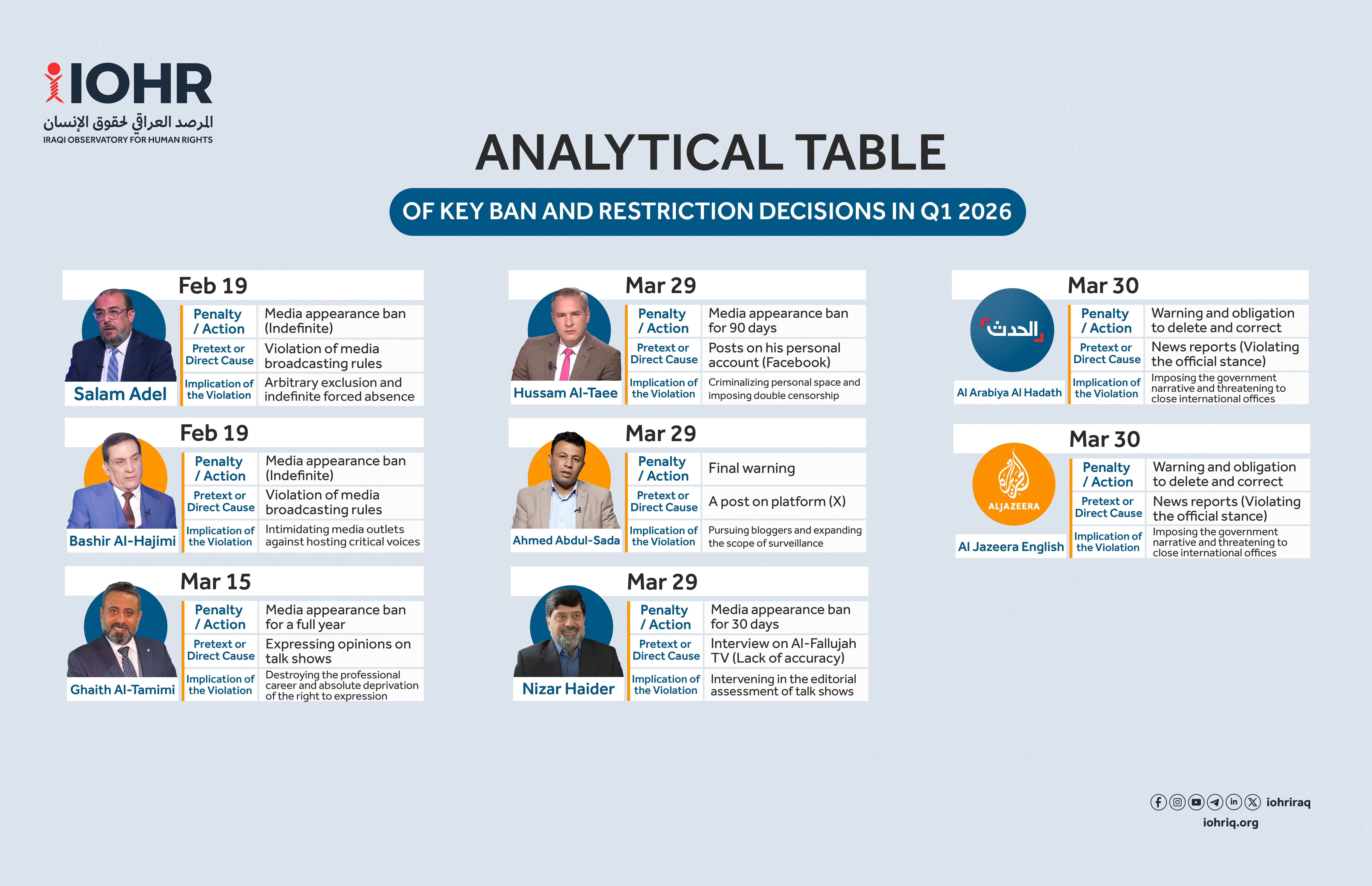
IOHR documented that this shift manifested in a series of decisions starting on February 19, when an indefinite media appearance ban was issued against political analysts Salam Adel and Bashir Al-Hajimi under the pretext of violating broadcasting regulations.
On March 15, the Observatory monitored a severe decision imposing a one-year media ban on political activist Ghaith al-Tamimi for expressing his views. By the end of the month, specifically on March 29, the scope of prosecution expanded to include personal digital spaces; Hossam Al-Tai, a presenter on Al-Sharqiya TV, was banned from appearing for 90 days due to Facebook posts. Similarly, political analyst Nizar Haidar was banned for 30 days following an interview on Al-Fallujah TV, cited for a "lack of accuracy," while blogger Ahmed Abd al-Sada received a final warning regarding a post on the (X) platform.
These measures were not limited to individuals but extended to international institutions. On March 30, warnings were issued to the Saudi-funded Al-Arabiya Al-Hadath and the Qatari-funded Al Jazeera English, mandating the deletion and "correction" of content under the pretext of publishing reports that contradict the official government stance.
The first three months of 2026 saw an unprecedented excessive use of vague terms such as "protecting social peace," "professional standards," and "combating low-quality content" to justify restrictions on freedom of expression. Such actions constitute a direct undermining of Article 38 of the Iraqi Constitution, a regression from Iraq's international obligations, and a transformation of the CMC’s regulatory role into a punitive-censorship body reminiscent of Information Ministries in authoritarian regimes.
IOHR states that this path reflects a clear trend toward the systematic narrowing of civic space, threatening to cause "Civic Desertification" by shrinking the arena for public debate and subjecting the digital sphere to state hegemony. This poses a direct threat to political and social pluralism in the country.
While the CMC was established under CPA Order No. 65 of 2004 to encourage open dialogue and promote pluralism, recent practices have raised significant concerns for IOHR. The Observatory fears the Commission is transitioning from a regulatory body into a tool for suppressing political and media discourse. Furthermore, although Article 103 of the Iraqi Constitution stipulates the Commission's independence, practical indicators show a decline in this independence, with decisions increasingly influenced by political balances and the double standards in applying regulatory rules.
IOHR documented that these media bans were issued without providing due process or clarifying the specific nature of the alleged violations, representing a direct interference in the independence of media institutions and their right to choose guests. The Observatory also monitored the CMC’s expansion into penalizing individuals for activities on their personal social media accounts—a double violation of freedom of expression, as individuals are professionalized penalized for their personal opinions.
While IOHR expresses deep concern over these restrictive measures, it continues to support the CMC in its mandate to organize the media landscape in Iraq, provided such efforts align with the constitutional guarantees stipulated in Article 38.
The most dangerous shift, however, is the CMC’s announcement to subject digital content to broadcasting rules, including activists and content creators, and the launch of a monitoring mechanism called the "Professional Commitment Registry." This is viewed as a pressure tool intended to induce self-censorship and restrict public debate. This approach ignores the distinct technical and legal nature of the internet and violates international standards that differentiate between traditional broadcasting and the open digital space.
IOHR emphasizes that these measures are a direct violation of Article 38 of the Iraqi Constitution, which guarantees freedom of expression and the press. They also exceed the CMC's designated regulatory powers and violate Iraq’s international commitments, particularly Article 19 of the International Covenant on Civil and Political Rights (ICCPR), which guarantees the right to share information without unjustified restrictions.
These practices reflect a clear democratic backsliding, the instrumentalization of legal frameworks to restrict expression, and the increasing militarization of the digital sphere. IOHR calls for the immediate cancellation of all bans and warnings, the cessation of prosecutions related to freedom of expression, and the launch of a comprehensive national dialogue to regulate the digital space in a manner that protects fundamental rights.
Protection of freedom of expression is a fundamental condition for maintaining the democratic path in Iraq. The continued use of regulatory tools to stifle the public sphere will undermine trust in institutions and close the doors to free debate, threatening the future of pluralism and human rights in the country.