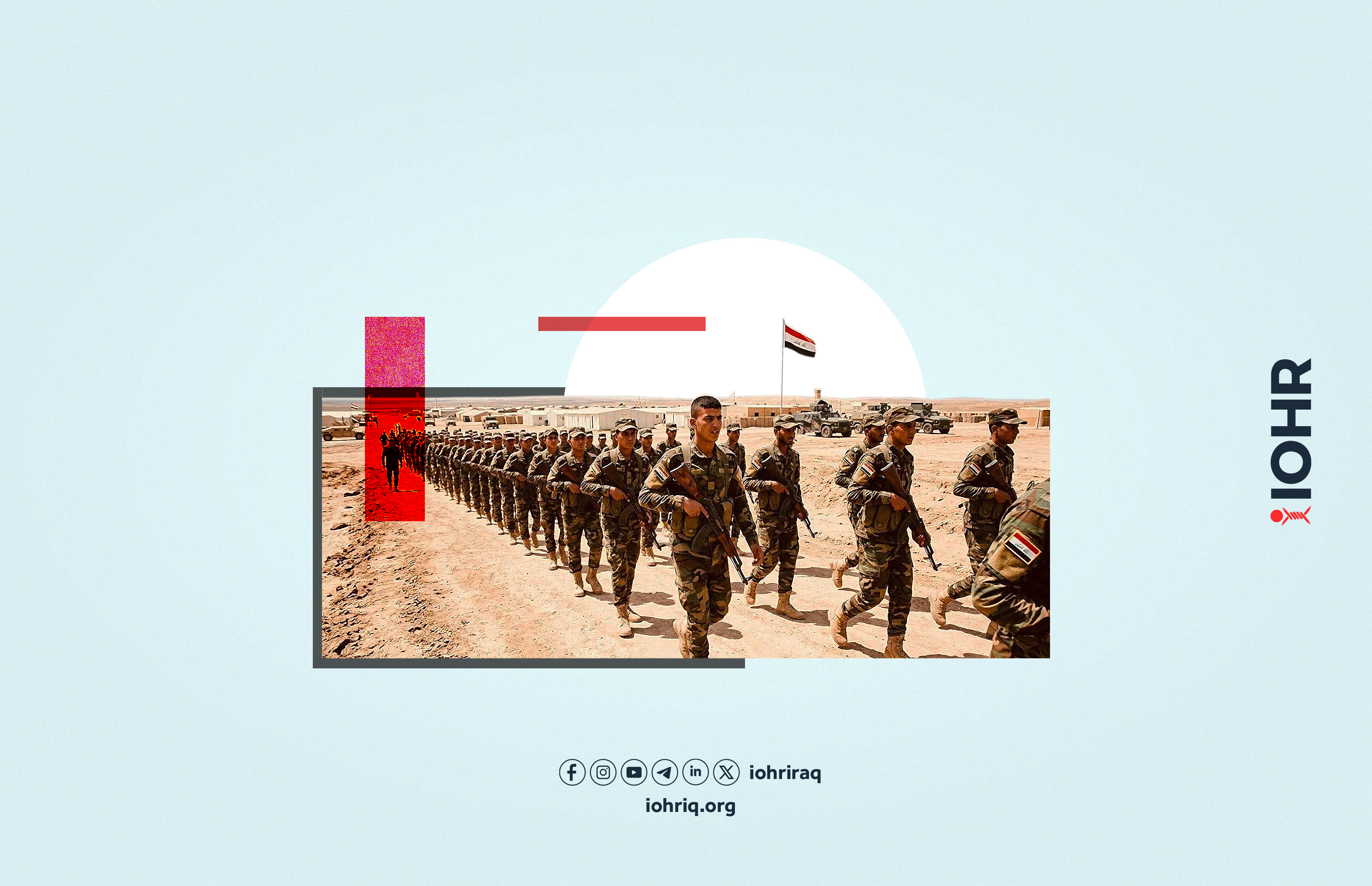

This statement addresses the IOHR's rejection of the "National Service" bill, viewing it as a move toward societal militarization and a violation of constitutional freedoms. The Observatory warns of economic burdens and class disparity through "exemption fees," asserting that addressing unemployment requires civil development, and demanding the law's withdrawal while prioritizing education to safeguard youth dignity.
The Iraqi Observatory for Human Rights (IOHR) stated that parliamentary efforts to reactivate the Compulsory Service Law, commonly known as "National Service," represent a dangerous step that undermines the civil path and encroaches upon fundamental freedoms guaranteed by the Iraqi Constitution and international conventions.
The Observatory further noted that this legislation—introduced at a time when Iraq is grappling with acute economic and structural crises—does not constitute a national necessity as much as it reflects an attempt to re-militarize society and divert youth potential toward institutions plagued by bureaucracy, corruption, and a lack of accountability.
According to provisions disclosed by local media and parliamentarians, the law reveals a political desire to subject an entire generation to the authority of the military establishment under flimsy pretexts such as "strengthening national cohesion" and "addressing unemployment." The Observatory contends that "national cohesion" is not built through physical coercion, but rather through achieving social justice, equality before the law, and ensuring decent work opportunities—areas where successive authorities have failed.
Context and Structural Failures
The current parliamentary movement seeks to restore a system that was frozen and dissolved in 2003 by the Coalition Provisional Authority (CPA). For two decades, Iraq relied on a voluntary system within the armed forces. However, structural failures and conflicting loyalties within the security apparatus have prompted certain political forces to demand the return of conscription as a "magic bullet" for discipline and human resource issues.
While the Parliamentary Security and Defense Committee asserts that the law aims to supply the army with "young blood" and address personnel shortages, the targeted age group (ranging from 18 up to 45 years in some cases) ignores the fact that the Iraqi army already suffers from numerical inflation coupled with a lack of qualitative efficiency. This is compounded by the existence of parallel armed formations that do not fall fully under the authority of the Commander-in-Chief of the Armed Forces.
Encroachment on Civil Liberties
The IOHR emphasized that subjecting civilians to military law upon being called for service—even before actual enlistment—opens the door to widespread violations regarding freedom of expression and assembly. Military law, by its nature, restricts political and protest activities, which could be utilized as a tool to neutralize youth activists. Furthermore, the "Military Service Booklet" will become a secondary identity document determining a citizen's fate regarding travel, employment, and even marriage in certain indirect cases.
Economic Burden and Systemic Misleading
In an economy entirely dependent on volatile oil prices and suffering from a structural liquidity deficit, proposals to grant conscripts salaries ranging from 600,000 to 700,000 IQD pose a massive financial burden. Estimates suggest that conscripting approximately 200,000 individuals annually would cost the public treasury billions of dollars—funds that should prioritize education, healthcare, and decaying infrastructure.
The claim that the law will tackle unemployment is systemic misleading. Unemployment is addressed by creating an investment-friendly environment and developing the private sector, not by turning youth into temporary wage-earners within the military. Moreover, the law imposes financial penalties on "draft evaders" reaching millions of dinars, burdening impoverished families and leaving them vulnerable to debt or judicial prosecution.
Institutionalized Inequality: The "Buy-out" Clause
One of the most controversial articles in the draft law is the provision for a "Financial Ransom" (Exemption Fee). This text guts the principle of "Equality before the Law" enshrined in the Constitution; the children of the wealthy and officials will be able to purchase their freedom, while the children of the poor are driven to the barracks. Converting a supposed "national duty" into a commodity is an insult to human dignity and entrenches class disparity. This system does not merely fund the state treasury; it fuels corruption networks surrounding the assessment of fees and the granting of exemptions.
International Law and Conscientious Objection
Compulsory enlistment in its current form conflicts with Article 18 of the International Covenant on Civil and Political Rights (ICCPR), which guarantees freedom of thought, conscience, and religion.
The Iraqi draft refuses to recognize "Conscientious Objection"—the right to refuse military service for moral, religious, or philosophical reasons—and provides no genuine civilian alternatives.
Forcing individuals to use or train with lethal force against their convictions is a violation of their psychological and physical integrity. Furthermore, banning Iraqis who have not served from traveling abroad is a flagrant violation of the right to freedom of movement, acting as a disproportionate restriction aimed at holding youth hostage within the country.
Militarization of Civil Space
The IOHR observes an increasing trend toward the militarization of civilian areas, where residential neighborhoods have turned into weapon depots and arenas for regional conflict. This legislation will deepen this phenomenon by instilling a military mindset in the youth instead of the values of civil citizenship and dialogue.
The Observatory believes that raising the issue of "National Service" at this time is intended to deflect attention from Parliament's failure to enact vital human rights legislation, such as the Anti-Domestic Violence Law, or the controversial amendments to the Personal Status Law that treat women as "second-class citizens."
Demands of the Iraqi Observatory for Human Rights
The IOHR demands the following:
Immediate Withdrawal of the Draft Law: The government and Parliament must cease legislative proceedings and acknowledge its failure as a solution for youth or security issues.
Security Sector Reform (SSR): Focus on professionalizing existing forces, ensuring legal accountability, and adhering to human rights standards rather than increasing numbers.
Investment in Education: Activate Compulsory Education Laws instead of compulsory military service to rescue millions from the cycle of illiteracy.
Demilitarization of Cities: Remove weapon depots and military headquarters from residential areas.
Inclusive National Dialogue: Decision-making regarding an entire generation must involve civil society organizations, unions, and the youth themselves.
The IOHR will continue to monitor this file and lobby against turning Iraq into a "Barracks State." Human dignity and freedom are the only guarantees for the country's stability. History has proven that armies built on coercion collapse at the first true test, while states that respect the will of their people and invest in their minds endure.